MATHEMATICS - TWO-STEP EQUATIONS

Solving Two Step Worksheet

  • Focuses on solving two-step equations with real-world applications
  • Includes scenarios involving negative numbers and operations
  • Challenges students with complex problem-solving situations
  • Designed for Grade 6 students with a hard difficulty level

Here are the first 3 questions. Click “View all questions” to see the complete assessment.

Q1.

Five less than negative three times a number is 16. Which equation represents this statement, and what is the number?

  1. A) 3x − 5 = 16, so x = 7.
  2. B) −3x + 5 = 16, so x = − 11/3.
  3. C) 3x + 5 = 16, so x = 11/3.
  4. D) −3x − 5 = 16, so x = − 7.

Q2.

Which situation represents −6x + 13 = − 29 and includes its correct solution?

  1. A) A number is multiplied by −6, and then 13 is subtracted to give −29; the number is 8/3.
  2. B) A number is multiplied by 6, and then 13 is added to give −29; the number is −7.
  3. C) A number is multiplied by −6, and then 13 is added to give −29; the number is 7.
  4. D) A number is added to 13, and the result is multiplied by −6 to give −29; the number is −49/6.

Q3.

There are 6 identical trays of eggs. Each tray originally contains the same number of eggs. After 9 eggs are removed, 63 eggs remain. Which equation represents the situation, and how many eggs were originally in each tray?

  1. A) 63 − 6x = 9, so each tray contained 9 eggs.
  2. B) 6x + 9 = 63, so each tray contained 9 eggs.
  3. C) 6x − 9 = 63, so each tray contained 12 eggs.
  4. D) 9x − 6 = 63, so each tray contained 23/3 eggs.

Q4.

An elevator starts on floor 23. It descends 6 floors during each movement and stops on floor −13. Which equation represents the situation, and how many movements does it make?

  1. A) −23 + 6m = − 13, so it makes 5/3 movements.
  2. B) 23 + 6m = − 13, so it makes −6 movements.
  3. C) 23 − 6m = − 13, so it makes 6 movements.
  4. D) 6m − 23 = − 13, so it makes 5/3 movements.

Q5.

Which situation is represented by 9 − 4h = − 27, and what is the value of h?

  1. A) A temperature starts at −9^(°)C and falls by 4^(°)C each hour until it reaches −27^(°)C; h = 9/2.
  2. B) A temperature starts at 9^(°)C and falls by 4^(°)C each hour until it reaches −27^(°)C; h = 9.
  3. C) A temperature of 9^(°)C is subtracted from 4 times the number of hours to give −27^(°)C; h = − 9/2.
  4. D) A temperature starts at 9^(°)C and rises by 4^(°)C each hour until it reaches −27^(°)C; h = − 9.

Q6.

A player begins a game with −15 points. The player earns 8 points in each successful round and finishes with 41 points. Which equation represents the situation, and how many successful rounds were played?

  1. A) −8r + 15 = 41, so the player completed −13/4 successful rounds.
  2. B) 8r − 15 = 41, so the player completed 7 successful rounds.
  3. C) −15r + 8 = 41, so the player completed −11/5 successful rounds.
  4. D) 8r + 15 = 41, so the player completed 13/4 successful rounds.

Q7.

Four more than negative seven times a number is −52. Which equation and solution correctly represent this statement?

  1. A) −7x + 4 = − 52, so x = 8.
  2. B) −7x − 4 = − 52, so x = 48/7.
  3. C) 4x − 7 = − 52, so x = − 45/4.
  4. D) 7x + 4 = − 52, so x = − 8.

Q8.

The equation 12 − 5e = − 33 describes a game score, where e is the number of errors. Which statement and value of e are correct?

  1. A) The score starts at 12, and 5 points are lost for each error until the score is −33; e = 9.
  2. B) The score starts at 12, and 5 points are gained for each error until the score is −33; e = − 9.
  3. C) The score starts at −12, and 5 points are lost for each error until the score is −33; e = 21/5.
  4. D) The score starts at 5, and 12 points are lost for each error until the score is −33; e = 19/6.

Q9.

The balanced scale in the figure shows identical closed boxes and individual unit cubes. If each box contains x cubes, which equation represents the figure, and what is x?
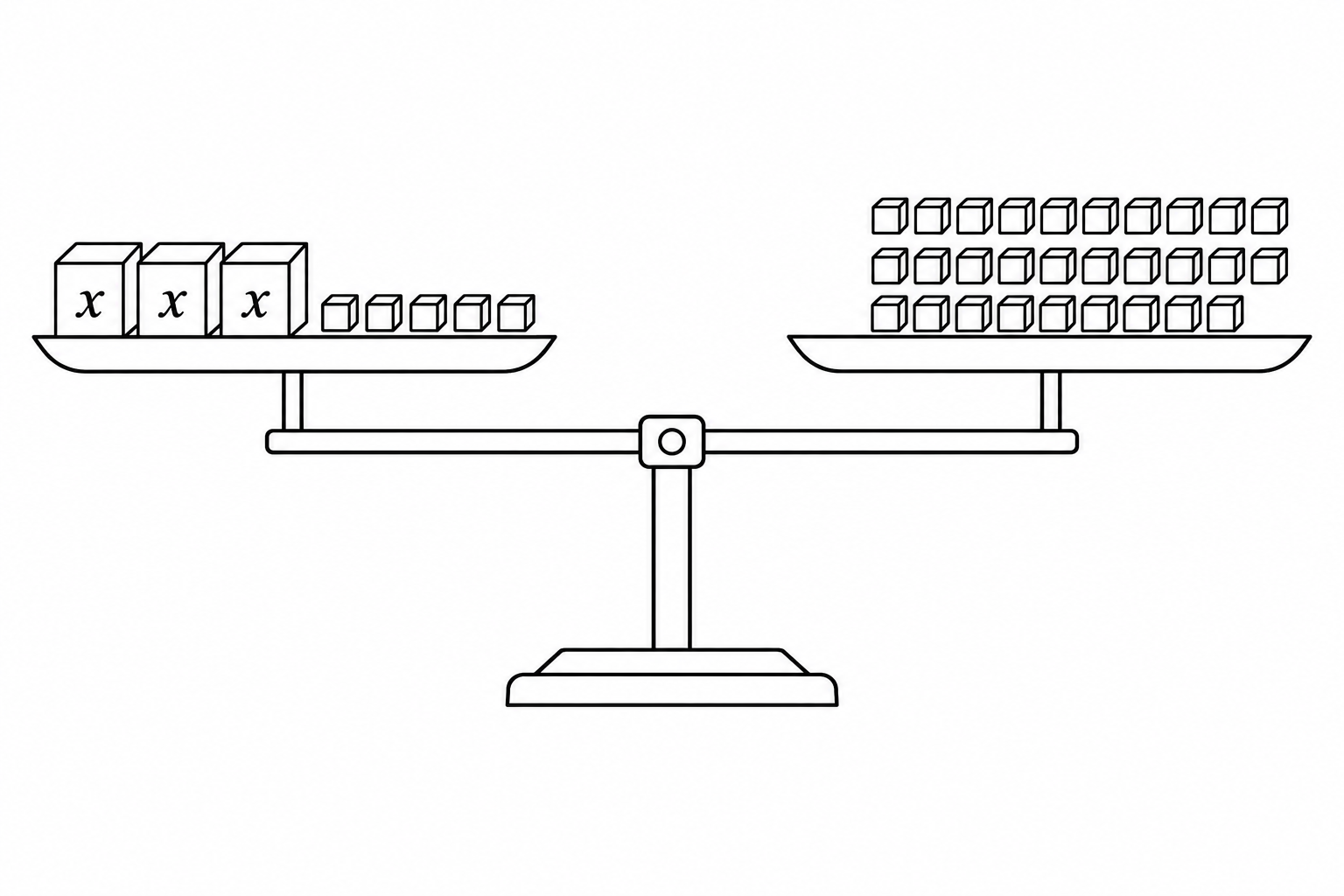
Diagram for question 9: The balanced scale in the figure shows identical closed boxes and individual unit cubes. If each box…
  1. A) 3x + 29 = 5, so x = − 8.
  2. B) 3x − 5 = 29, so x = 34/3.
  3. C) 3x + 5 = 29, so x = 8.
  4. D) 5x + 3 = 29, so x = 26/5.

Q10.

The figure shows a number machine. Which equation represents the machine, and what input value should replace x?
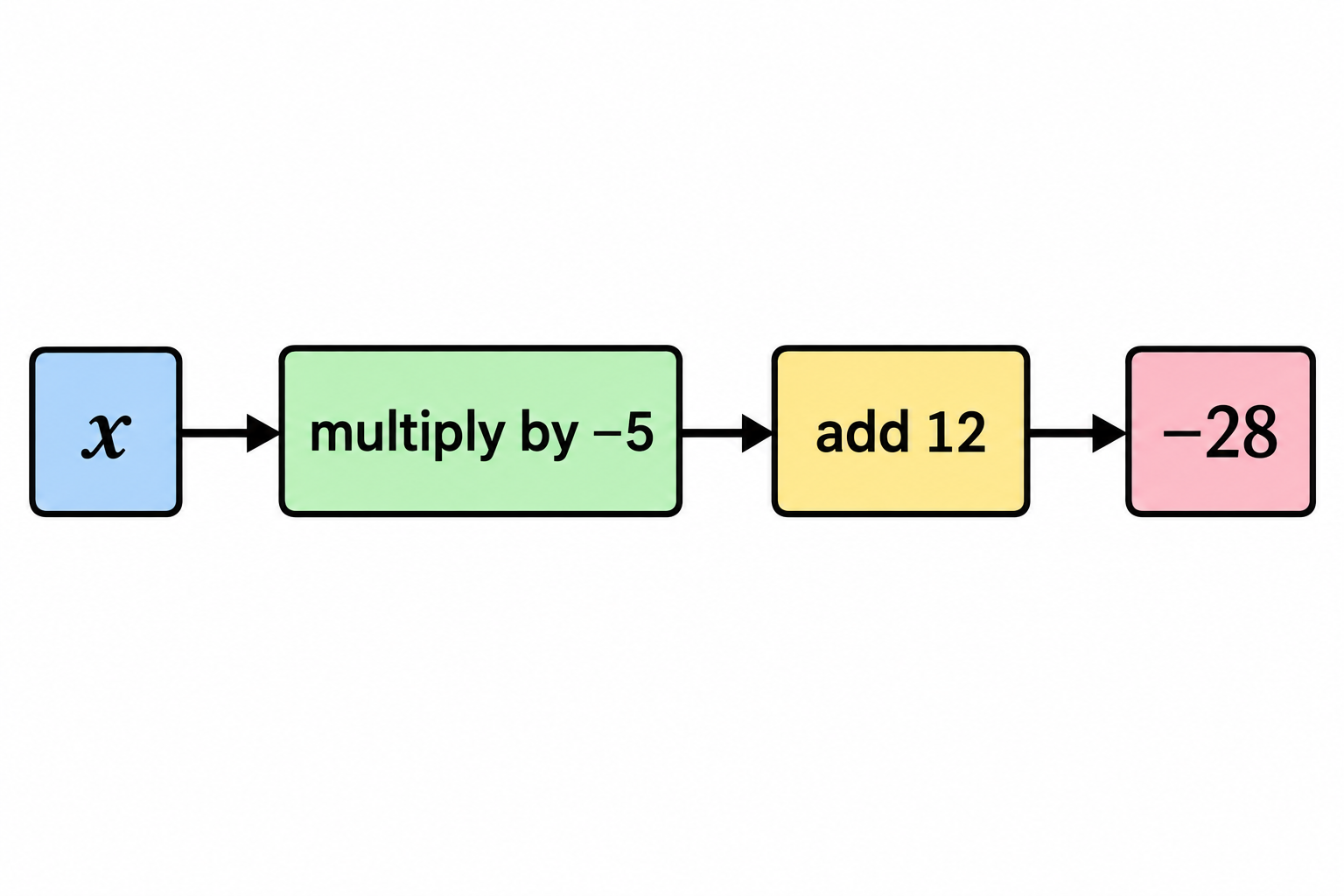
Diagram for question 10: The figure shows a number machine. Which equation represents the machine, and what input value should…
  1. A) −5x − 12 = − 28, so x = 16/5.
  2. B) −5(x + 12) = − 28, so x = − 32/5.
  3. C) 5x + 12 = − 28, so x = − 8.
  4. D) −5x + 12 = − 28, so x = 8.

What this assessment covers

Concepts tested

  • Two-step equations
  • Negative numbers in equations
  • Real-world problem translation into equations
  • Balancing equations
  • Understanding of variables

Question Mix

  • Hard questions included

Skills you build

  • Translate word problems into mathematical equations
  • Solve two-step equations accurately
  • Apply operations with negative numbers
  • Interpret real-world scenarios mathematically
  • Identify and solve for variables in equations