

MATHEMATICS - SIMPLIFYING EXPRESSIONS
Combining Like Terms Worksheet
- Focuses on simplifying algebraic expressions by combining like terms
- Covers the application of the distributive law in algebraic contexts
- Includes problems on identifying and correcting errors in algebraic simplification
- Designed for Grade 6 students to practice medium difficulty algebra skills
Here are the first 3 questions. Click “View all questions” to see the complete assessment.
Q1.
Q2.
Simplify 4(2a − 3) + 5a by applying the distributive law and collecting like terms.
Q3.
Which expression has the same value as 3(2p + 5) − 4p for every value of p?
Q4.
Which line correctly shows how to collect the like terms in 9m − 2 + 4 − 5m?
Q5.
A rectangle has length 2x + 3 and width x + 5. Which expression represents its perimeter in simplest form?
Q6.
A student writes 5(2y + 1) − 3y = 7y + 1. Which statement best explains the student's error?
Q7.
Which term must be added to 6(n − 2) so that the result simplifies to 9n − 12?
Q8.
What is the simplest form of 3(2r − 4) − 2(r + 1) + 5?
Q9.
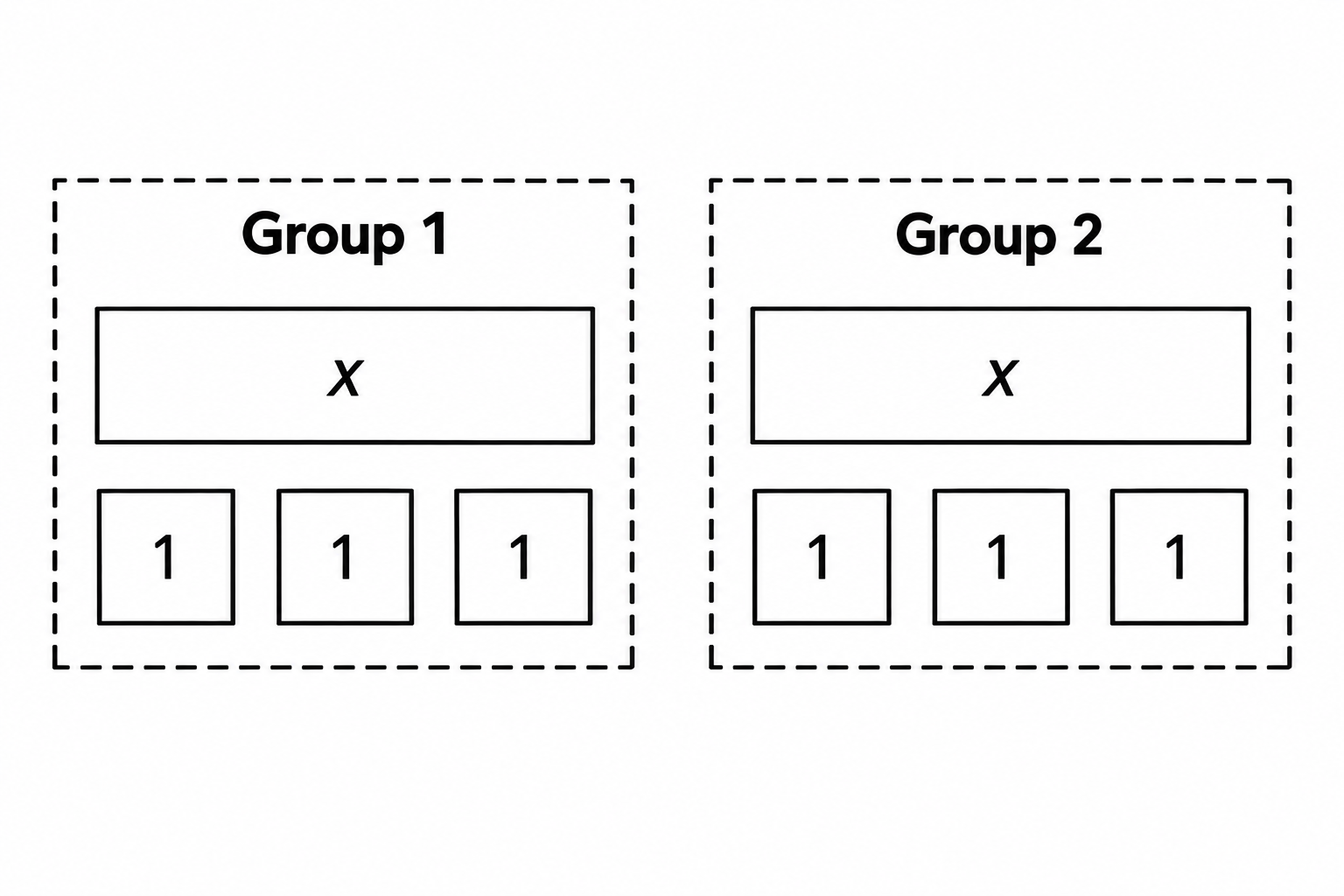
The figure shows two identical groups of algebra tiles. Which expression represents all the tiles after applying the distributive law and collecting like terms?
Q10.
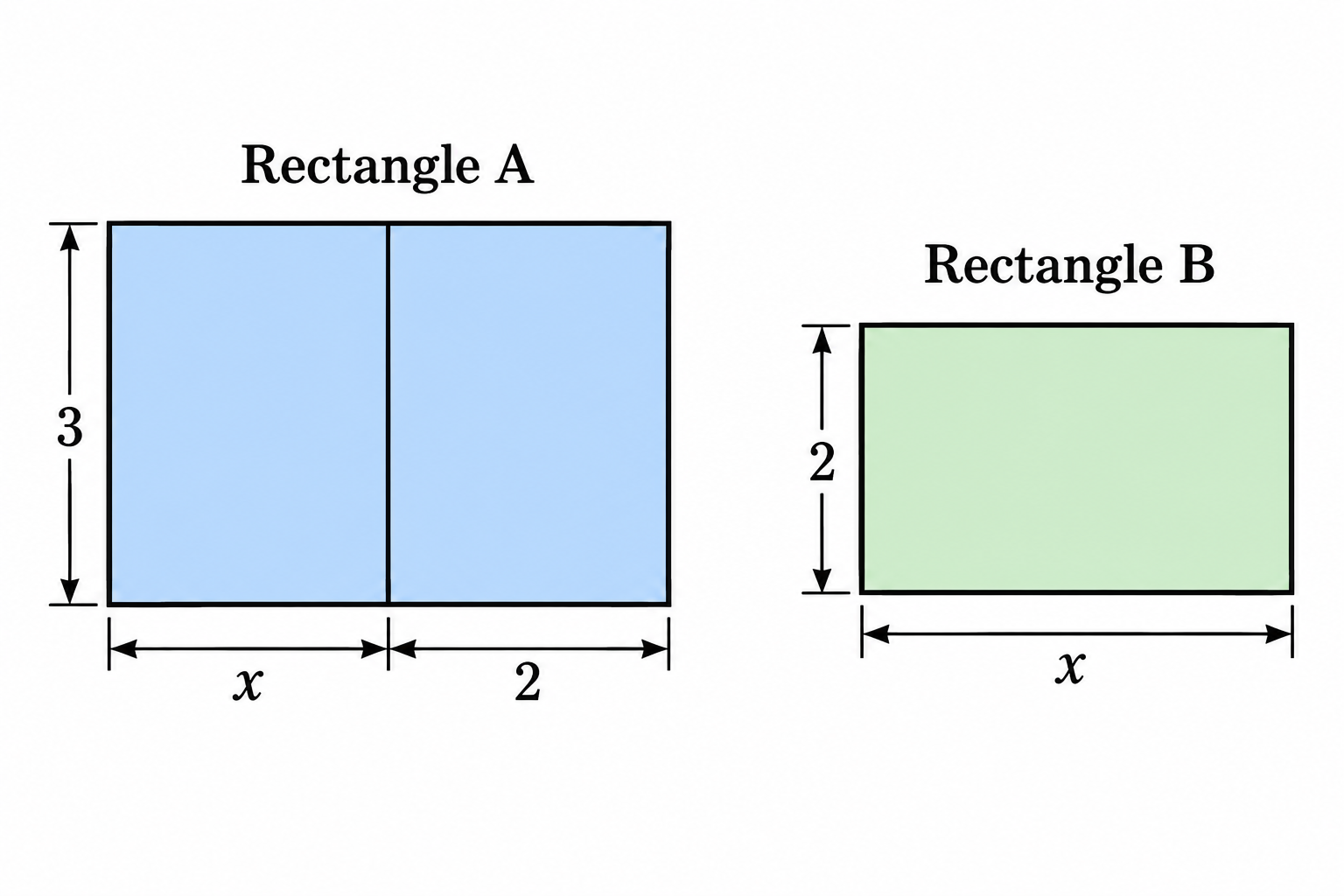
The figure contains two shaded rectangles. Which expression represents their total area in simplest form?
What this assessment covers
Concepts tested
- Combining like terms in algebraic expressions
- Applying the distributive property to simplify expressions
- Understanding equivalent expressions
- Identifying errors in algebraic simplification
- Calculating perimeters and areas using algebra
Question Mix
- Medium questions included
Skills you build
- Simplifying expressions by combining like terms
- Applying the distributive law to algebraic expressions
- Identifying equivalent algebraic expressions
- Analyzing and correcting algebraic errors
- Calculating geometric properties using algebraic expressions
Related assessments
More practice
Other assessments in this subject
