

CHEMISTRY - CHEMICAL EQUATIONS
Balancing Equations Worksheet
- Focuses on balancing chemical equations using smallest whole-number coefficients
- Includes reactions involving combustion, oxidation, and synthesis
- Challenges students with complex multi-step reactions
- Designed for Grade 9 students with advanced chemistry skills
Here are the first 3 questions. Click “View all questions” to see the complete assessment.
Q1.
Q2.
Iron pyrite is roasted according to FeS2 + O2 → Fe2O3 + SO2. Which is the correctly balanced equation using the smallest whole-number coefficients?
Q3.
Sodium thiosulfate reacts with hydrochloric acid as shown: Na2S2O3 + HCl → NaCl + SO2 + S + H2O. Which sequence gives the smallest whole-number coefficients in the order shown?
Q4.
Calcium nitride reacts with water according to Ca3N2 + H2O → Ca(OH)2 + NH3. Which sequence gives the coefficients of Ca3N2, H2O, Ca(OH)2 and NH3 after balancing?
Q5.
Ammonia is oxidised to nitrogen monoxide and water: NH3 + O2 → NO + H2O. Which is the correctly balanced equation?
Q6.
Phosphorus is manufactured using the equation Ca3(PO4)2 + SiO2 + C → P4 + CaSiO3 + CO. Which sequence gives the smallest whole-number coefficients in the order shown?
Q7.
In acidic solution, the ionic equation is MnO4− + H+ + Fe2+ → Mn2+ + Fe3+ + H2O. Which sequence gives the smallest whole-number coefficients in the order shown while balancing both atoms and charge?
Q8.
Copper reacts with concentrated nitric acid according to Cu + HNO3 → Cu(NO3)2 + NO2 + H2O. Which equation is correctly balanced using the smallest whole-number coefficients?
Q9.
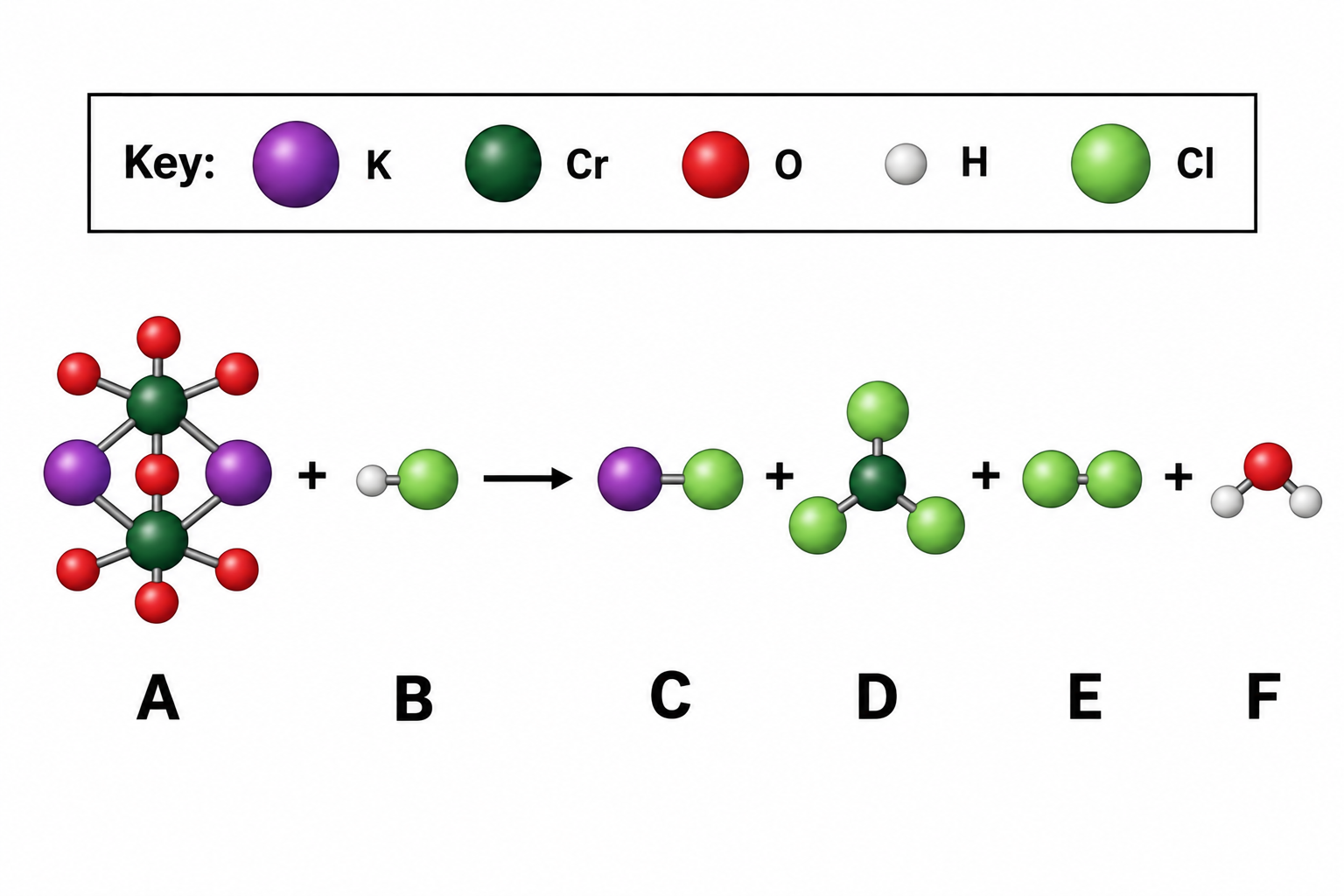
The particle models in the figure represent the six substances in reaction A + B → C + D + E + F. Which sequence gives the smallest whole-number coefficients for A, B, C, D, E and F, respectively?
Q10.
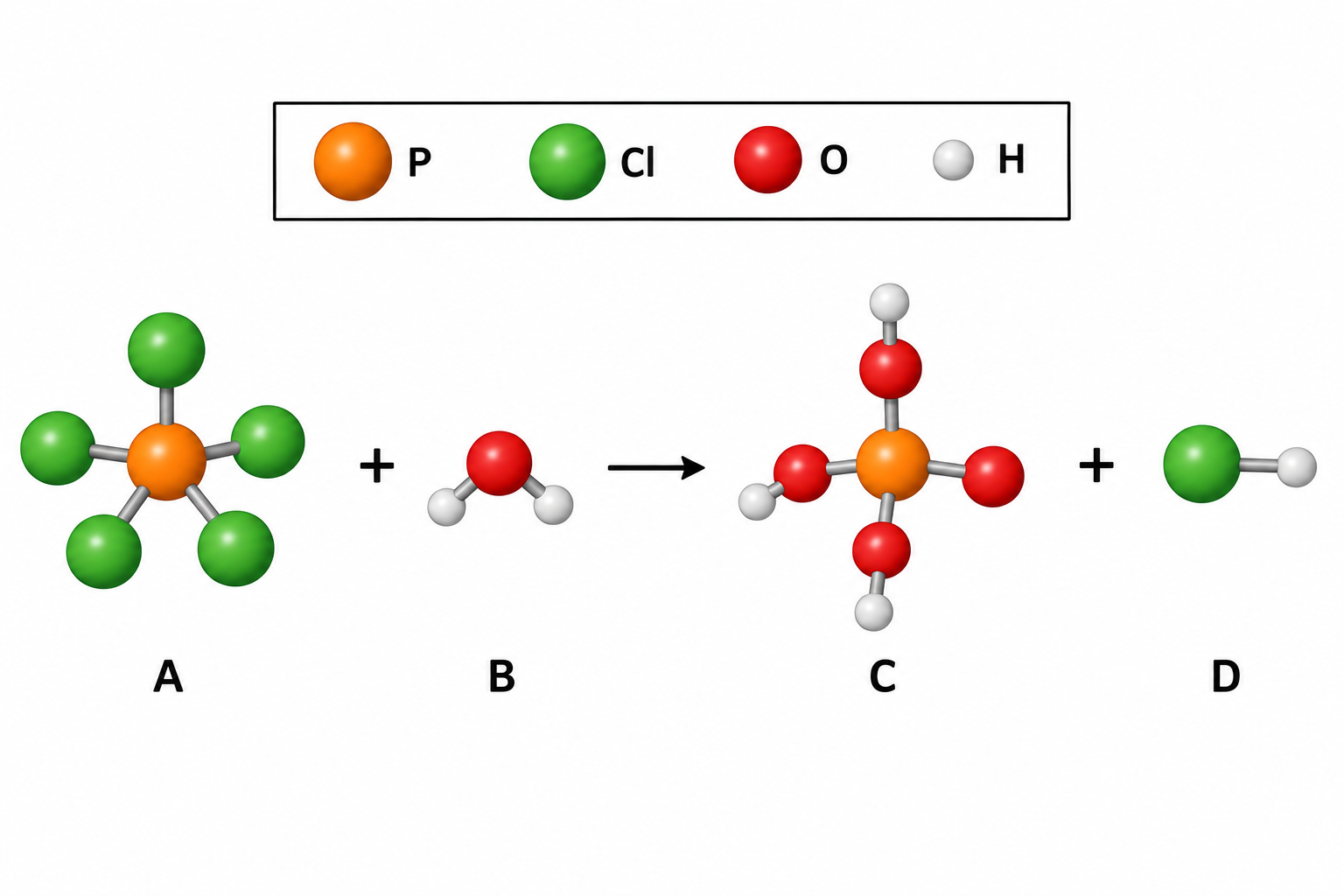
The molecular models in the figure show reaction A + B → C + D. Which sequence gives the smallest whole-number coefficients for A, B, C and D, respectively?
What this assessment covers
Concepts tested
- Balancing chemical equations
- Combustion reactions
- Oxidation-reduction reactions
- Synthesis reactions
- Stoichiometry in chemical equations
Question Mix
- Hard questions included
Skills you build
- Identify correct coefficients for balanced equations
- Apply stoichiometry to balance reactions
- Analyze chemical reactions for atom and charge balance
- Interpret chemical equations from particle models
- Solve complex chemical balancing problems
Related assessments
More practice
Other assessments in this subject
