

BUSINESS - FINANCIAL STATEMENTS
Balance Sheet Practice Questions
- Focuses on classifying assets and liabilities in financial statements
- Covers real-world business scenarios for practical understanding
- Emphasizes understanding of short-term and long-term financial obligations
- Designed for Grade 9 students with a challenging difficulty level
Here are the first 3 questions. Click “View all questions” to see the complete assessment.
Q1.
Q2.
At its year end, a business has a bank loan of $60,000. It must repay $12,000 during the next 12 months and the remaining $48,000 after three years. How should the loan be classified?
Q3.
A design company has a software licence that it will use for four years, insurance paid in advance for the next six months, and an unpaid electricity bill due next week. How should these items be classified, in order?
Q4.
A property development business owns an office building used by its employees and three newly built houses intended for sale to customers. Which classification is correct?
Q5.
A hotel receives a deposit for a conference that will take place in three months. It is also waiting to receive payment from a guest who has already completed a stay. How should the deposit and the amount owed by the guest be classified?
Q6.
At the reporting date, a manufacturer's loan is contractually due for repayment in 15 months. No part of it is payable before then. Which classification should be used?
Q7.
A vehicle dealer owns a tow truck used to recover customers' vehicles and ten new cars held for sale. It also owes the car manufacturer for stock delivered on 30-day credit. Which classification is correct?
Q8.
A business has machinery, a positive cash balance, a bank overdraft repayable on demand, and a five-year debenture. Which option classifies all four items correctly?
Q9.
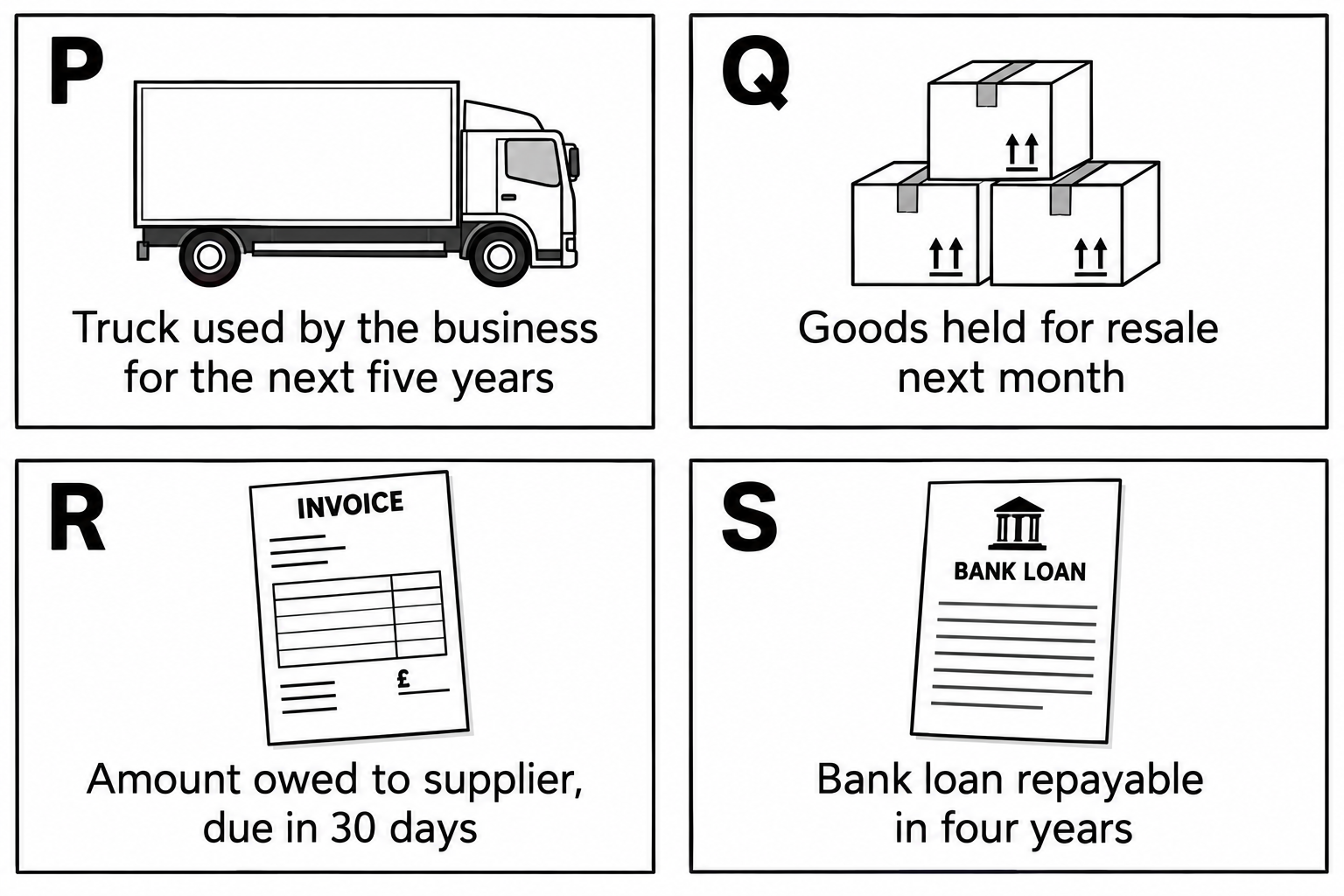
Study the four labelled business items in the figure. Which option gives the correct classification of P, Q, R and S, in that order?
Q10.
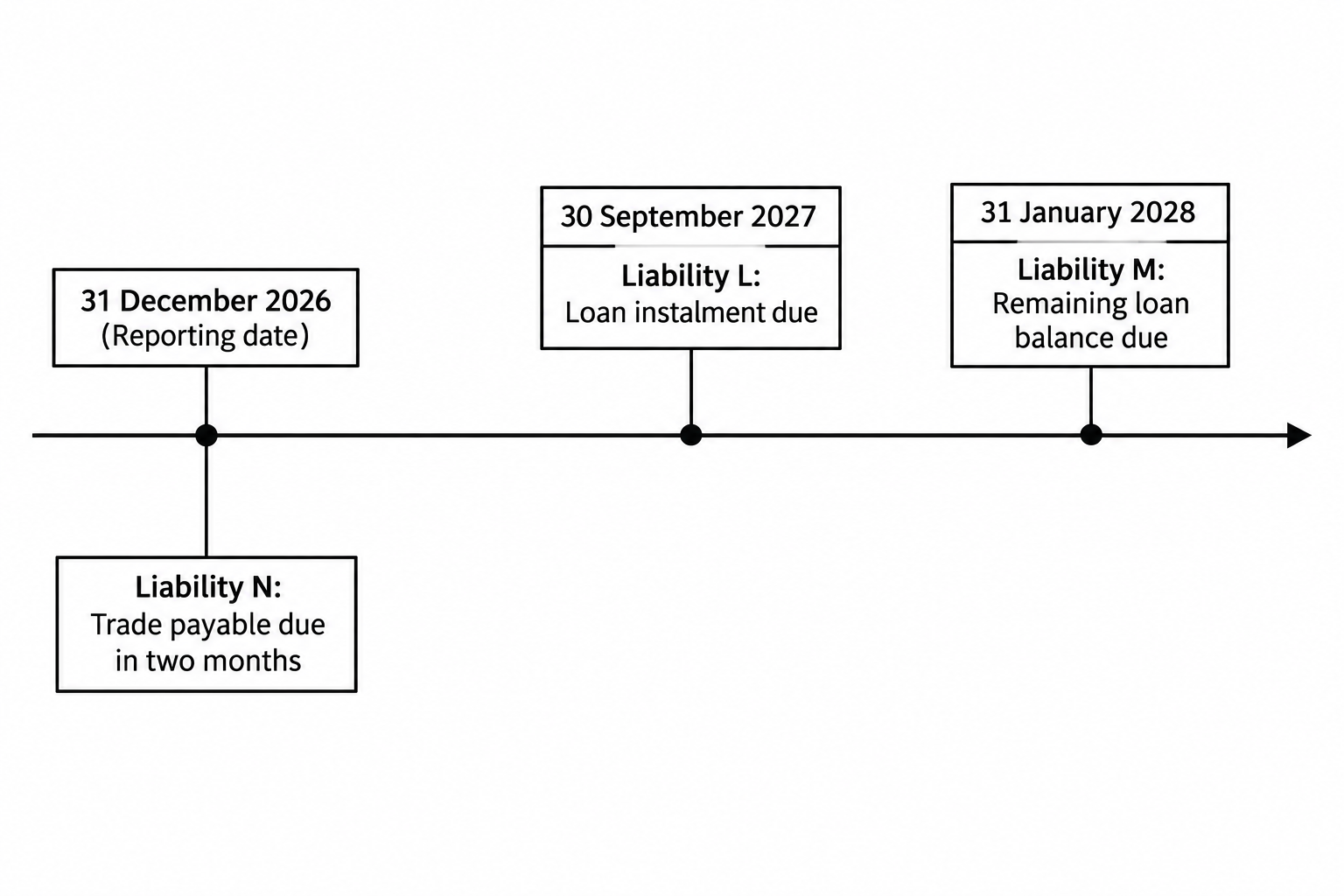
Use the reporting date and payment timeline in the figure. How should liabilities L, M and N be classified, in that order?
What this assessment covers
Concepts tested
- Classification of current and non-current assets
- Understanding of liabilities and their classifications
- Differentiation between short-term and long-term obligations
- Recognition of prepaid expenses and accrued liabilities
- Identification of tangible and intangible assets
Question Mix
- Hard questions included
Skills you build
- Classify business assets and liabilities accurately
- Interpret financial data in business contexts
- Apply accounting principles to real-world scenarios
- Analyze financial obligations based on timeframes
- Evaluate business transactions for financial reporting
Related assessments
More practice
Other assessments in this topic
