Choose the correct answer:
Aluminium reacts with chlorine according to 2Al + 3Cl₂ → 2AlCl₃. A mixture contains 5.40 g of aluminium and 10.65 g of chlorine. What mass of aluminium chloride can be formed? Use Ar: Al = 27.0, Cl = 35.5.
Choose the correct answer:
Aluminium reacts with chlorine according to 2Al + 3Cl₂ → 2AlCl₃. A mixture contains 5.40 g of aluminium and 10.65 g of chlorine. What mass of aluminium chloride can be formed? Use Ar: Al = 27.0, Cl = 35.5.
Choose the correct answer:
A 5.00 g sample of impure calcium carbonate is added to 80.0 cm³ of 1.00 mol/dm³ hydrochloric acid. The excess acid requires 20.0 cm³ of 0.500 mol/dm³ sodium hydroxide for complete neutralisation. Given CaCO₃ + 2HCl → CaCl₂ + CO₂ + H₂O, what is the percentage by mass of CaCO₃ in the sample? Use Mr(CaCO₃) = 100.
Choose the correct answer:
Carbon burns according to C + O₂ → CO₂. When 12.0 g of carbon is heated with 40.0 g of oxygen, 33.0 g of carbon dioxide is collected. What is the percentage yield of carbon dioxide? Use Ar: C = 12.0, O = 16.0.
Choose the correct answer:
A 10.0 cm³ sample of sulfuric acid is diluted to 250 cm³. A 25.0 cm³ portion of the diluted solution requires 30.0 cm³ of 0.200 mol/dm³ sodium hydroxide for neutralisation. Given H₂SO₄ + 2NaOH → Na₂SO₄ + 2H₂O, what was the concentration of the original sulfuric acid?
Choose the correct answer:
Nitrogen and hydrogen react completely according to N₂(g) + 3H₂(g) → 2NH₃(g). At the same temperature and pressure, 12 dm³ of nitrogen is mixed with 30 dm³ of hydrogen. What is the total volume of the gaseous mixture after the reaction is complete?
Choose the correct answer:
A 24.5 g impure sample of potassium chlorate contains 80.0% KClO₃ by mass. It decomposes completely according to 2KClO₃ → 2KCl + 3O₂. What volume of oxygen is produced at room temperature and pressure? Use Mr(KClO₃) = 122.5 and molar gas volume = 24.0 dm³/mol.
Choose the correct answer:
A Group I metal carbonate has the formula M₂CO₃. A 2.12 g sample reacts completely with excess hydrochloric acid and produces 480 cm³ of carbon dioxide at room temperature and pressure. Identify M. Use molar gas volume = 24.0 dm³/mol and Ar: Li = 7.0, Na = 23.0, K = 39.0, Rb = 85.5.
Choose the correct answer:
A student mixes 100 cm³ of 0.150 mol/dm³ barium chloride with 80.0 cm³ of 0.100 mol/dm³ sodium sulfate. Barium sulfate precipitates according to Ba²⁺(aq) + SO₄²⁻(aq) → BaSO₄(s). Assuming volumes are additive, what is the concentration of Ba²⁺ ions remaining after the reaction?
Choose the correct answer:
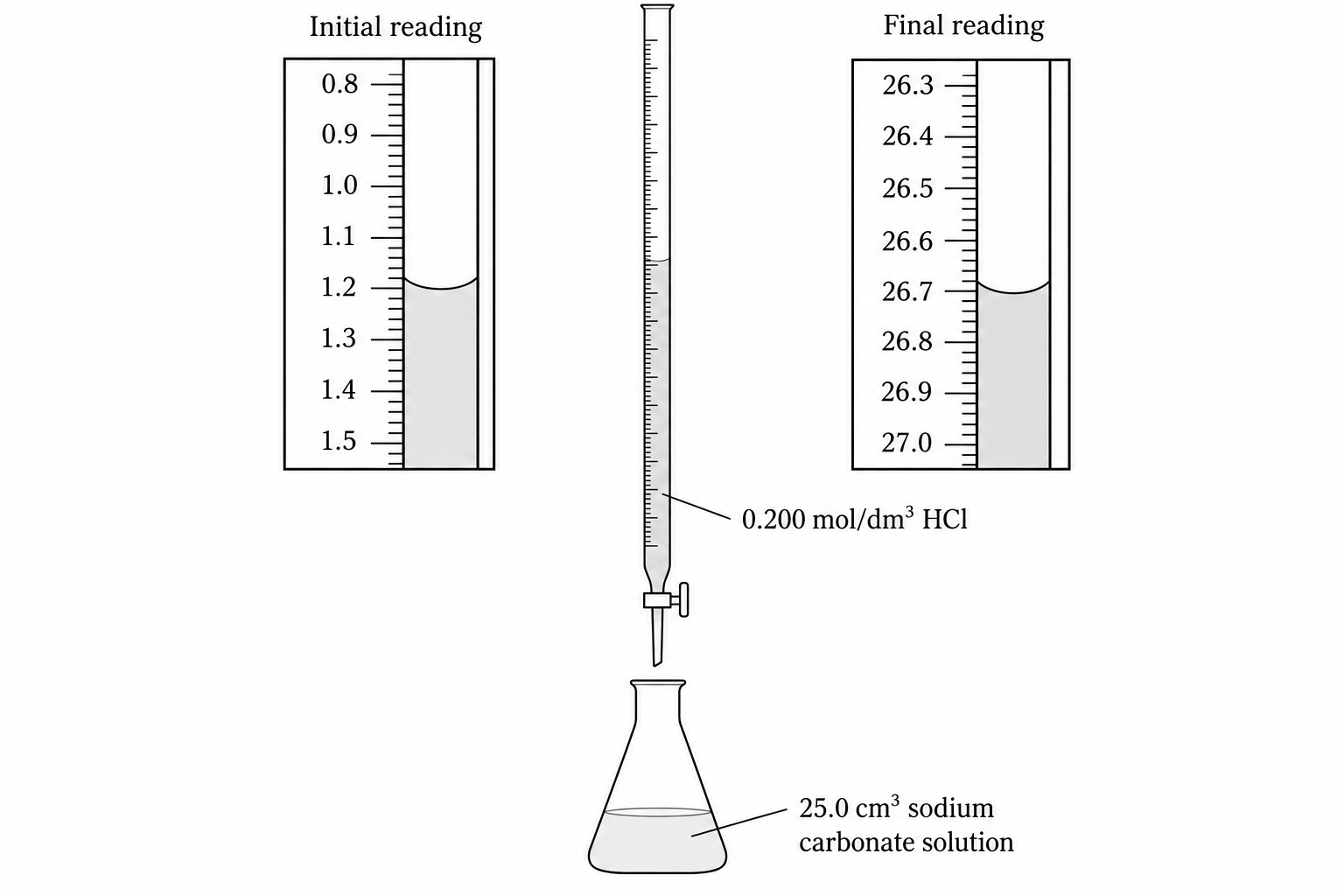
The diagram shows the initial and final burette readings when hydrochloric acid is added to 25.0 cm³ of sodium carbonate solution. The acid concentration is 0.200 mol/dm³. Given Na₂CO₃ + 2HCl → 2NaCl + CO₂ + H₂O, what is the concentration of the sodium carbonate solution?
Choose the correct answer:
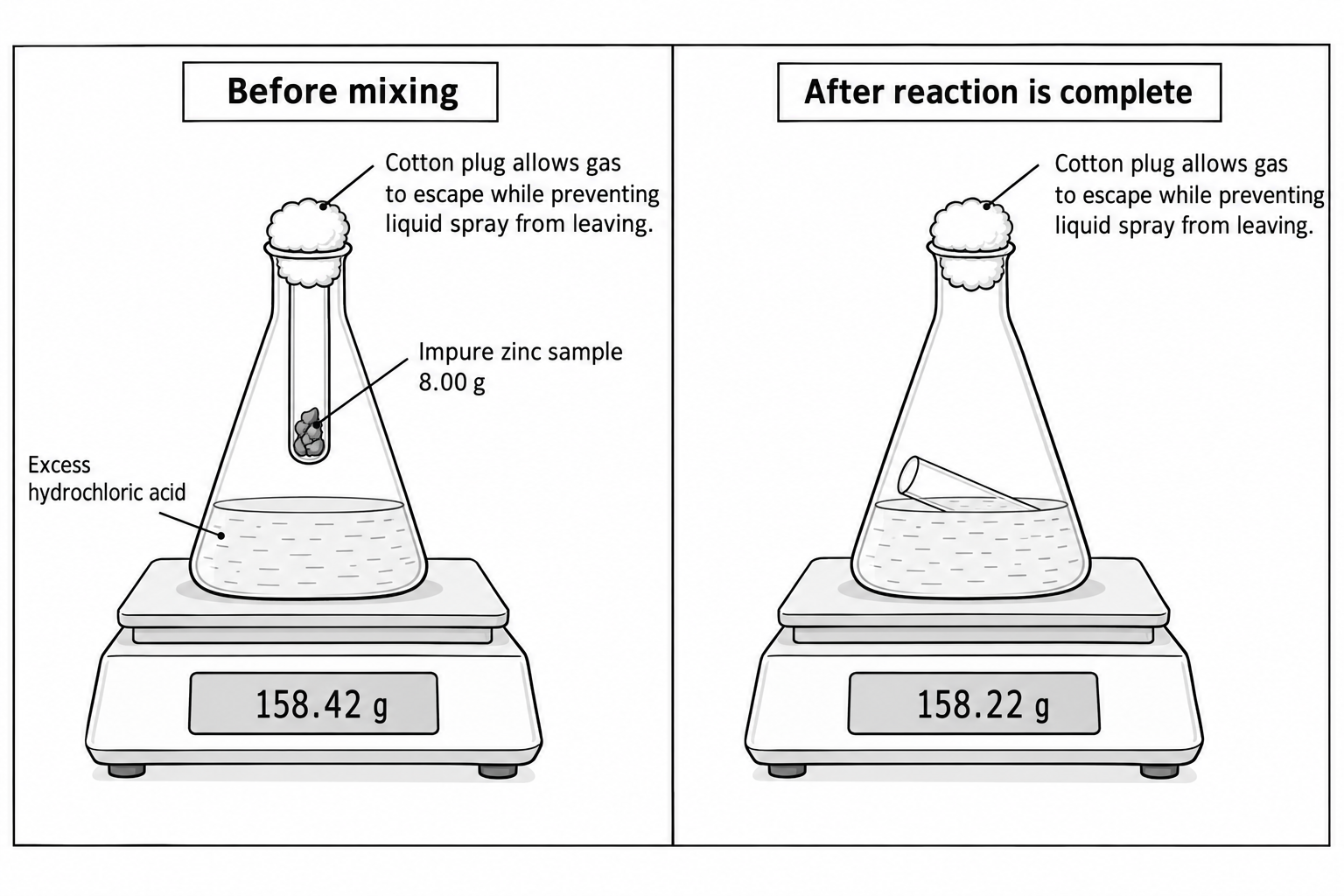
The diagram shows an experiment in which an 8.00 g impure zinc sample reacts completely with excess hydrochloric acid. All the mass lost from the apparatus is hydrogen gas. Given Zn + 2HCl → ZnCl₂ + H₂, calculate the percentage by mass of zinc in the sample. Use Ar(Zn) = 65.4 and Mr(H₂) = 2.00.